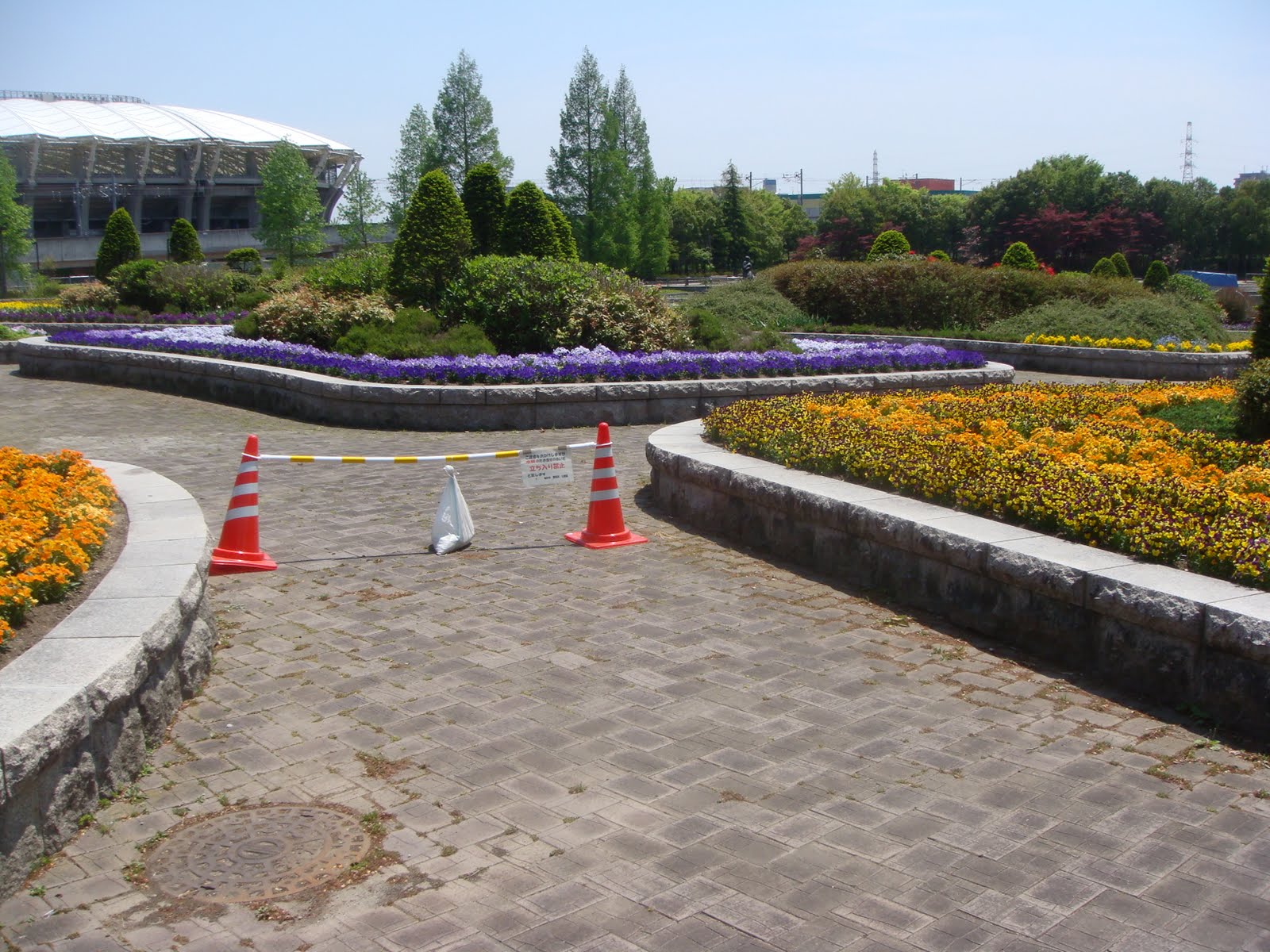
The flowers were in full bloom (when they aren't, they plant something that is) and were beautiful.
This is a shallow man-made pond that is often full of ducks but on this day there were none. I guess they were all off minding their eggs. The squarish structure in the middle of the pond is a fountain that varies the shape and height of the spray. I do not expect to see it this year. The government will be doing everything it can to reduce the consumption of electricity and this uses electric pumps. Because of the lose of the nuclear reactors in Fukushima and of other regular power plants during the disaster, they do not expect to be able to generate enough electricity to keep up with demand this summer.
This is a wooden bridge over the little stream that feeds into the pond.
This path goes along the edge of the river, along the top of the levee. The soccer stadium is in the background.
Note: Today is going to be very busy. I have an art lesson in the morning and then in the afternoon I am going to the above stadium to watch Vegalta play. Kyoko and Tsubasa left after supper last night and arrived saftely at home in Tokyo sometime after midnight. It seems strange not to have a baby running around the house and wanting to play.
May 28, 2011
May 27, 2011
Avoiding Izumi Chuo by going through Nanakita Koen
Instead of going through the center of Izumi Chuo, I decided to bypass it by going south and passing through part of Nanakita Koen (Nanakita Park). While still on the road to the park I passed this store - a scuba dive shop. It seems rather strange since this is really a side street and it is a long way from the water.
This is the last building before the entrance to the park. It is quite new, only a year or so old, but still it was badly enough damaged that it is having extensive work done on it, as is obvious from the scaffolding.
Inside the park there was damage to the walkways. This is where the sidewalk passes the entrance to the parking lot.
This group had a bunch of children and two foreign men and a couple of Japanese women. When I got up close enough to hear them, I realized that it was a group for one of the local kindergartens, one that specializes in early English education. I should probably point out that the person sitting on the extreme right is actually a bronze statue.
This building contains a botanical garden, but it has been closed since the earthquake. I have been told that it is quite good but I have never managed to tour the inside. From the outside, I can see that there are many trees and large plants inside. I expect that at some point I will go in with a sketchbook and do some drawings, so that I can use the plants in my pictures.
At this end (east) of the park there are large areas of flowers that are constantly transplanted so that it is constantly ablaze with color. The structure in the background is the south end of Vegalta's soccer stadium. Actually the stadium is named the Yurtec Stadium this year. They sell the naming rights to help pay for the operation.
This is one of the stone sculptures that are placed around the park. In the open area there was a large group of women, probably college students. There were a few women trying to organize the group, but I did not stay to see what was going on.
A little further on I found some older men getting ready to fly model airplanes. These were small and powered with rubber bands, the kind of plane that I used to make when I was a kid. This large open area is a great place to fly planes and there are often small groups flying gliders or rubber band powered planes. I have never seen planes with an engine, and I suspect that they are prohibited.
This is the last building before the entrance to the park. It is quite new, only a year or so old, but still it was badly enough damaged that it is having extensive work done on it, as is obvious from the scaffolding.
Inside the park there was damage to the walkways. This is where the sidewalk passes the entrance to the parking lot.
This group had a bunch of children and two foreign men and a couple of Japanese women. When I got up close enough to hear them, I realized that it was a group for one of the local kindergartens, one that specializes in early English education. I should probably point out that the person sitting on the extreme right is actually a bronze statue.
This building contains a botanical garden, but it has been closed since the earthquake. I have been told that it is quite good but I have never managed to tour the inside. From the outside, I can see that there are many trees and large plants inside. I expect that at some point I will go in with a sketchbook and do some drawings, so that I can use the plants in my pictures.
At this end (east) of the park there are large areas of flowers that are constantly transplanted so that it is constantly ablaze with color. The structure in the background is the south end of Vegalta's soccer stadium. Actually the stadium is named the Yurtec Stadium this year. They sell the naming rights to help pay for the operation.
This is one of the stone sculptures that are placed around the park. In the open area there was a large group of women, probably college students. There were a few women trying to organize the group, but I did not stay to see what was going on.
A little further on I found some older men getting ready to fly model airplanes. These were small and powered with rubber bands, the kind of plane that I used to make when I was a kid. This large open area is a great place to fly planes and there are often small groups flying gliders or rubber band powered planes. I have never seen planes with an engine, and I suspect that they are prohibited.
May 26, 2011
Still headed for Izumi Chuo
The last time I came by there this building contained a restaurant specializing in yakiniku. At a yakiniku restaurant they bring plates of raw meat and vegetables to your table and you cook them yourself on a grill that is usually gas and embedded in the table. Now it is called Earth Support and is a center for home helpers, people who go to homes to assist the elderly and the sick.
Down the street there is a gas station, where regular gas was selling for 149 yen per liter, or US$ 6.88 a gallon. Since the disaster, the supply chain for gas has been restored and there are no longer any shortages, at least in Sendai. I do not know what the situation is like in the areas destroyed by the tsunami.
A little closer to Izumi Chuo, I saw a woman working in a rice paddy. She was planting rice in the spots that had been missed by the automatic planter.
The paddy is fairly big by Japanese standards. You can see the gas station in the distance on the right. Rice paddies are generally pretty small and there are absolutely no huge operations like you find in California or some other parts of the US. After WW2, Japan limited the size of farms to insure that everyone would be able to support themselves. I believe that a nuclear family was limited to 2 1/2 acres, but I could be wrong. There has been some relaxation of the laws and people can and do rent paddies, but the farms are still relatively small.
Turning and looking across the street, you can see a large hospital. This is the one that I went to when I had a kidney stone attack and they refused to see me because it was early morning and the one doctor on duty was already waiting for an ambulance that was bringing an emergency patient.
I was now in the built up area to the west of the Izumi Chuo subway station. The content of this imitation brick (real bricks collapse in earthquakes so they are seldom used) building is actually quite unusual. The building contains a coffee shop called Kenzo. Compared to Nagoya there are very few coffee shops in Sendai. That is one of the reasons that I like Starbucks so much. There are a number of shops in places that I commonly go and I like the coffee.
This place, with the red and yellow flags in front of it, is a curry shop. It is part of a chain that is cheap but good tasting. On TV I have seen blind taste tests where people have chosen this curry over real Indian curry. Since it is on the west side of the station, I never seem to remember it when I eat in Izumi Chuo. I really should keep it in mind.
This truck is a Coop truck, the Coop being the supermarket that I show a couple of days ago. The woman in the yellow T-shirt is delivering orders to the people who live in the apartment house whose shadow you can see on the sidewalk. The man in the helmet is a delivery person who came on a motorcycle that is out of the picture. As I walked up the two were talking so I assumed that they knew each other.
Down the street there is a gas station, where regular gas was selling for 149 yen per liter, or US$ 6.88 a gallon. Since the disaster, the supply chain for gas has been restored and there are no longer any shortages, at least in Sendai. I do not know what the situation is like in the areas destroyed by the tsunami.
A little closer to Izumi Chuo, I saw a woman working in a rice paddy. She was planting rice in the spots that had been missed by the automatic planter.
The paddy is fairly big by Japanese standards. You can see the gas station in the distance on the right. Rice paddies are generally pretty small and there are absolutely no huge operations like you find in California or some other parts of the US. After WW2, Japan limited the size of farms to insure that everyone would be able to support themselves. I believe that a nuclear family was limited to 2 1/2 acres, but I could be wrong. There has been some relaxation of the laws and people can and do rent paddies, but the farms are still relatively small.
Turning and looking across the street, you can see a large hospital. This is the one that I went to when I had a kidney stone attack and they refused to see me because it was early morning and the one doctor on duty was already waiting for an ambulance that was bringing an emergency patient.
I was now in the built up area to the west of the Izumi Chuo subway station. The content of this imitation brick (real bricks collapse in earthquakes so they are seldom used) building is actually quite unusual. The building contains a coffee shop called Kenzo. Compared to Nagoya there are very few coffee shops in Sendai. That is one of the reasons that I like Starbucks so much. There are a number of shops in places that I commonly go and I like the coffee.
This place, with the red and yellow flags in front of it, is a curry shop. It is part of a chain that is cheap but good tasting. On TV I have seen blind taste tests where people have chosen this curry over real Indian curry. Since it is on the west side of the station, I never seem to remember it when I eat in Izumi Chuo. I really should keep it in mind.
This truck is a Coop truck, the Coop being the supermarket that I show a couple of days ago. The woman in the yellow T-shirt is delivering orders to the people who live in the apartment house whose shadow you can see on the sidewalk. The man in the helmet is a delivery person who came on a motorcycle that is out of the picture. As I walked up the two were talking so I assumed that they knew each other.
May 25, 2011
Still returning from Parktown
Instead of going up over the hill and approaching Izumi Chuo from the north like I usually do, I decided to turn right and go down the hill and then approach from the west. I had not been on this road for a long time so it was an interesting walk.
On the way down the hill, near the athletic dome that I showed a few days ago, I found a ramen shop with this picture on the outside of the entrance. The writing is a poem-like composition about how ramen tastes and smells as you slurp down the noodles and the hot soup passes over your tongue and goes down your throat.
When we had a car, we came here quit often, but I have not been here for at least two years. This is a parcel delivery service office. In Japanese the service is called takkyubin. Now that we do not have a convenient way to get here we have the service come to the house to pick up packages. It costs a bit more but is better.
This area used to be a large open field with some woods at the back. A few years ago they cut down all the trees and flattened the land. Now they have built a shopping center.
This picturesque driveway came right out to the main street. I took this picture from the sidewalk. The house at the end was nothing special, just a regular old, cheap building of the type that was built when this area was first opened up for housing.
A little bit further down the road was the rice producer's cooperative. The building on the left is the first of three large temperature controlled storage structures for the rice grown in the area. The building on the right seems to be an administrative space. The wall-less structure in the middle is a store that is only open for a period of a few months around the harvest.
This stele is tucked in the woods beside the coop's land. It is in honor of the Japaneses war dead. Notice that someone has placed fresh flowers on it.
Behind the above stele there is a similar one but even further into the woods.
As I was walking back out of the woods, I noticed that fuji, wisteria, was growing in the trees. It was just past its prime but was still very pretty.
On the way down the hill, near the athletic dome that I showed a few days ago, I found a ramen shop with this picture on the outside of the entrance. The writing is a poem-like composition about how ramen tastes and smells as you slurp down the noodles and the hot soup passes over your tongue and goes down your throat.
When we had a car, we came here quit often, but I have not been here for at least two years. This is a parcel delivery service office. In Japanese the service is called takkyubin. Now that we do not have a convenient way to get here we have the service come to the house to pick up packages. It costs a bit more but is better.
This area used to be a large open field with some woods at the back. A few years ago they cut down all the trees and flattened the land. Now they have built a shopping center.
This picturesque driveway came right out to the main street. I took this picture from the sidewalk. The house at the end was nothing special, just a regular old, cheap building of the type that was built when this area was first opened up for housing.
A little bit further down the road was the rice producer's cooperative. The building on the left is the first of three large temperature controlled storage structures for the rice grown in the area. The building on the right seems to be an administrative space. The wall-less structure in the middle is a store that is only open for a period of a few months around the harvest.
This stele is tucked in the woods beside the coop's land. It is in honor of the Japaneses war dead. Notice that someone has placed fresh flowers on it.
Behind the above stele there is a similar one but even further into the woods.
As I was walking back out of the woods, I noticed that fuji, wisteria, was growing in the trees. It was just past its prime but was still very pretty.
Subscribe to:
Posts (Atom)