May 24, 2011

Returning from Parktown

 This hillside next to the main road from Parktown to Izumi Chuo looks like a jungle, but when we lived in Parktown a little more than 10 years ago, it was very different. The complex of apartment buildings of the other side of the road was quite new and the this hillside was nicely landscaped. There was a large area of grass with carefully planted bushes that blossomed at different times and that had leaves that were different colors. However, as with almost all landscaping like this, no one has done anything to it in years and it is rapidly going back to nature, although nature with some plants that were not originally there.
 This is on the same hillside but a little nearer Izumi Chuo. In reality it is a flight of stairs that lead to a path at the top. The path then goes over the hill and enters the back of a graveyard. I was tempted to walk up and see how the gravestones had fared in the quakes, but it was too overgrown to use. When we used to live here I occasionally walked up to the top because there is a good view down the length of the Nanakita River valley.
 Beside the road I found something that I had not noticed before - a working telephone. In this age of cell phones, phone booths have become few and far between. The buildings in the background are a bit unusual and I have something to say about them below.
 The long one-story building in the front is a clinic specializing in internal and children's medicine. The multistory building in the back, though, is unusual. It is a condo for retired people. In addition to the doctor in the clinic, there is 24/7 nursing services and everything else that you might need can be obtained for a price. They staff will do your cooking and cleaning, there is a restaurant, the staff will go shopping for you, and they will do anything else that you want or need. My understanding is that there are fixed prices for everything and if you have enough money it is a great place to live. I do not have that sort of income so I will never live there.
 On the other side of the building, which is now on the right of the picture, I saw something that is sadly very common this year. A construction crew is cutting down large old trees that were weakened during one of the quakes and could fall down. It is very sad to see these majestic old trees being killed.
As I got nearer to Izumi Chuo, I passed an area that used to be rice paddies, but it looks like they are not going to plant this year. The older farmers plant each year but when they reach an age where they can not do it anymore, no one takes over from them. Their children have moved away, often to Tokyo, and are working at a regular job that is less strenuous and financially more rewarding than rice farming. Once this happens the fields remain empty until they are sold and someone puts up houses or stores.

The local newspaper today had a sobering article. In Miyagi Prefecture, due to the earthquakes and tsunami, 186 hospitals and clinics were damaged or completely destroyed. That certain helps to explain the apparent increase in patients at my doctor's.

May 23, 2011

Hachiman Jinja in Parktown

 I walked along the path and arrived at the back of the small hill. The first thing I saw was two torii, the gates that mark the entrance to a shrine. One of them, however, was in pieces on the ground
 A small stone stele had broken into half and the top was also laying on the ground.
 There are actually two small shrines that are situated side by side in new roofed structures with concrete block walls to protect the original shrines. Both are quite similar.
 This shows the inside of the second building. It contains a traditional style wooden shrine. I am sure that there is some thing to represent the god Hachima behind the closed doors
 Hachiman is a strange god. He was a Shinto god related to war, but after Buddhism was introduced and the Japanese started to assimilate Shinto gods and stories into Buddhism, Hachiman became a Bodhisattva. So this Buddhist style statue was not out of place on the shrine grounds, even though it had fallen over during one of the quakes.
 This is a side view of the protective buildings. You can just see the shape of the wooden shrine building under the roof. The building on the right is used during festivals and other gatherings as a place to store things and as a place to meet. Often such buildings are used for the eating and drinking that accompany a festival.
 The shrine is beside the Expressway so it is quite noisy one the grounds. The shrine is off to the right on the other side of the divided road.
 The road I was on has a bridge that carries it over the Expressway. In spite of having a lot of work done on it during the last couple of years, the bridge was still badly damaged during the disaster. This picture shows the temporary repair work that was done to make passable the almost 15 centimeter difference in height that developed between the road surface on the bridge and that on land.
After crossing the bridge I had a good view of the athletic dome where the high schools have various competitions.

May 22, 2011

Still in Parktown

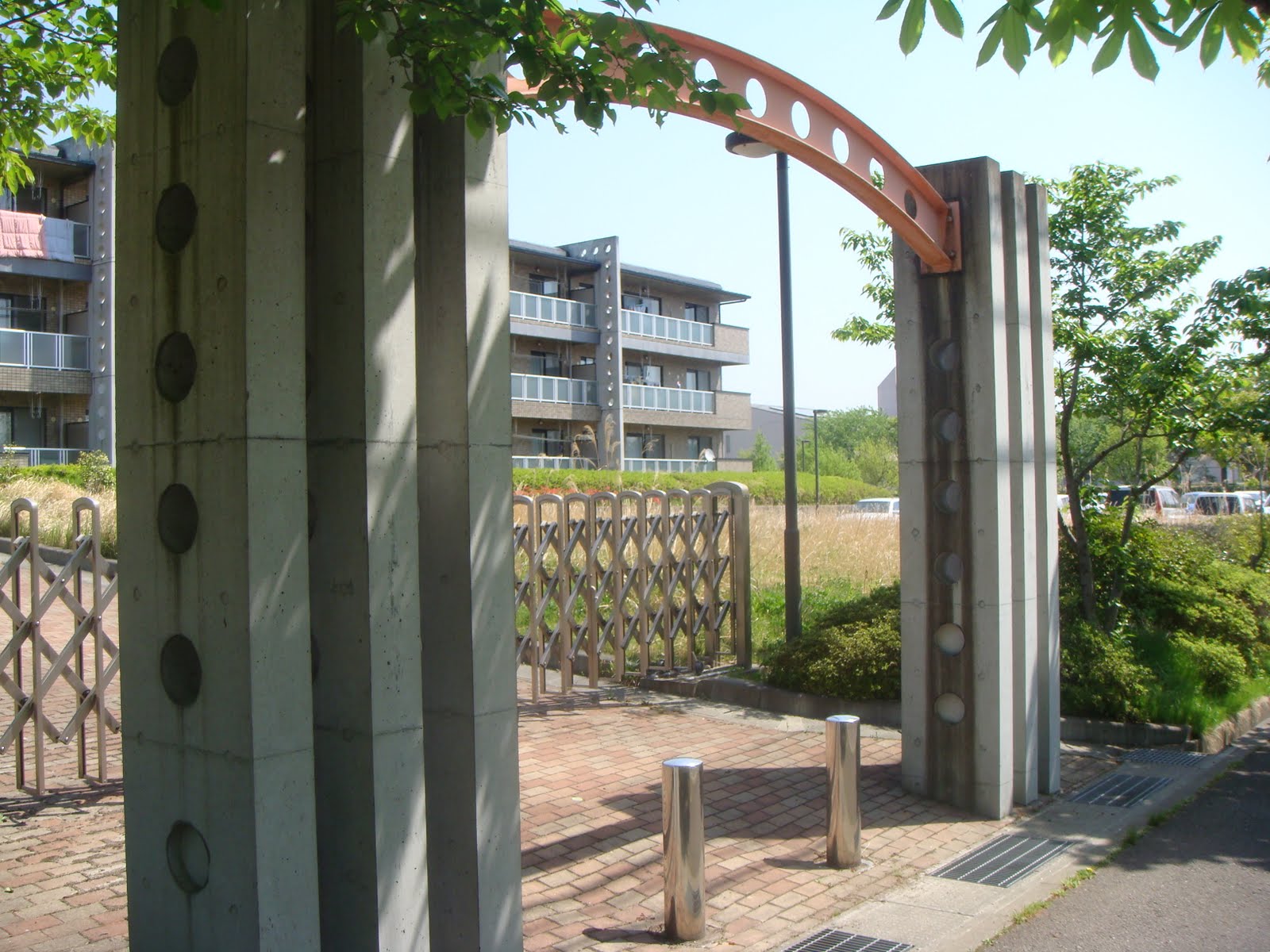
This is my old apartment (2nd floor on the right end) as seen through the front gate of the Miyagi U faculty housing area. One interesting thing about this gate is that it is never used. It is in the middle of the block with no parking and no particular reason to be there. The back side of the plot has two entrances and is on a side road, so everyone uses them. I do not remember seeing this gate open since it was locked to prevent people from taking a shortcut between the buildings.
This is a ramen (noodle) shop and what I consider the best I have ever been in. The food is excellent and the owner keepd it spotlessly clean. Most ramen shops are pretty grubby.
This is my dentist's. Since it is in Parktown, he and his wife live on the top floor and the office is on the first floor.
This is the entrance. The signs are ads in favor of specific politicians. Both the husband and wife are dentists and they also have a couple of young women who are technicians. As with my doctor the office is well equipped, having an X-ray machine, molding equipment for making false teeth, and the things necessary for minor oral surgery.
After I left, I walked a block south to a large intersection where there is a coop supermarket. It actually is a coop. You can become a member and get a large discount as well as have regular deliveries of food to your home. We have done it twice, but have not liked the lacking of choice that shopping in a store gives you. Probably when we get even older and getting to a store becomes a problem, we will join again. As I walked by the Coop and headed home, I remembered that behind the store there is a Shinto shrine. I decided to check and see if it had been damaged.
The path around the little hill that hides the shrine was constructed from old railroad ties, The are laid out in pairs that are held together by heavy u-shaped nails. This picture is looking back out toward the road and the structure on the right is the back of the Coop.

May 21, 2011

A trip to Parktown - continued

 This is the far end of the park, away from my doctor's. The shrubs on the slope are trimmed to say ta-ka-mo-ri-hi-ga-shi-ko-en, or East Takamori Park.Behind the top of the hill, you can just see the tops of some buildings. Together they constitute the local junior high school.
 One surprising thing is this area is the amount of wisteria that is growing wild. Many trees are partially covered with it.
 This is looking across the lake from the other side. You can see the koinobori that I showed before.
 One reason I come to the park was to use the public toilet. As usual the urinals are open to the view of anyone passing by the outside. When I first came to Japan back around 1970 it was not at all uncommon for me to just pee wherever they happened to be - into sewers, against walls, at the edges of parks, beside the road. Now there are nor public toilets and the only men you see peeing outdoors is an occasional taxi driver and a few construction workers. It has become very much out of fashion and extremely unusual. Actually younger Japanese males are now quite shy in this regard.
 On the back side, actually the front since it is facing the road, there is a very nice fountain, but I have never seen water running in it.
This is the Miyagi U faculty housing again, but from the other end. I used to live on the second floor at the right end.