This is a place to hang written wishes in the hope that they will become reality. Actually in Buddhism this sort of thing is not possible in the strictest sense, but many people believe anyway.
This shows a detail of how traditional buildings are made in Japan. There are no nails. Here a slot was cut in the upright and a horizontal piece was slid into it, spanning the space between uprights. Then rather than nailing the horizontal piece in place a wedge is pounded into the slot, holding everything together. In an earthquake this type of construction allows a huge amount of movement of the individual pieces, while maintaining the integrity of the whole structure.
As I was leaving I saw a newer building behind one of the others. This building is quite large and seemed to be in use at the moment. Also there was a bicycle parked by the building on the left. Then three people came from behind the building.
The walked around to the front of this building, climbed the stairs, and after unlocking the door entered. At this point I did not have my camera in my hand and by the time I got it ready they were inside.
Temples and shrines always have a large sign, usually stone, announcing their name and sect affiliation. This temple is, as I have said, Daitokuji of the Shingon Sect. A little ways down the hill on the same road I had arrived on, I saw a parking lot full of cars. I now knew that this lot was directly behind the new building in the third picture above so I assumed that these cars belonged to the people in the building.
Back at the Shinkansen tracks I decided to see where this road went. I crossed at the lights and found this, an auto repair shop specializing in 4x4s.
Showing posts with label Buddhism. Show all posts
May 30, 2013
Nov 22, 2012
Ryuhoji
Up under the eaves of the pagoda I notice a colorful but unidentifiable animal of some sort.
Another Buddhist statue with fresh flowers but again I do not know who it represents.
This is the little Shinto shrine that is next to the main hall. The statues of two foxes in front of the torii, two in this case, plus the fact that the torii are red implies that this is one of the Inari Shrines. Inari is the Shinto god (kami) of fertility, rice, agriculture, foxes, industry, and worldly success. Apparently about one third of the shrines in Japan are dedicated to Inari.
Some one has place a container of rice wine, sake, between the legs of this fox.
This is the beginning of a small construction project. I know this because of the bamboo poles at the four corners of the space and right in the middle (very hard to see) a shorter pole with folded white paper hanging from it. This shows that the Shinto ceremony to bless the site has been completed. This was done even though this is a Buddhist temple.
This is a strong storage house where the temple keeps it valuables, mostly art work, I would imagine. This storage buildings have thick walls, strong windows and doors, and would be very hard to break into without making a huge amount of noise for a long time.
Another Buddhist statue with fresh flowers but again I do not know who it represents.
This is the little Shinto shrine that is next to the main hall. The statues of two foxes in front of the torii, two in this case, plus the fact that the torii are red implies that this is one of the Inari Shrines. Inari is the Shinto god (kami) of fertility, rice, agriculture, foxes, industry, and worldly success. Apparently about one third of the shrines in Japan are dedicated to Inari.
Some one has place a container of rice wine, sake, between the legs of this fox.
This is the beginning of a small construction project. I know this because of the bamboo poles at the four corners of the space and right in the middle (very hard to see) a shorter pole with folded white paper hanging from it. This shows that the Shinto ceremony to bless the site has been completed. This was done even though this is a Buddhist temple.
This is a strong storage house where the temple keeps it valuables, mostly art work, I would imagine. This storage buildings have thick walls, strong windows and doors, and would be very hard to break into without making a huge amount of noise for a long time.
Nov 21, 2012
Ryuhoji
If you remember, we were escorting a guest, the father of an Australian friend, and he had little experience in Japan. We stopped here in front of the bell tower and were talking about Buddhism and temples. The idea of Shinto shrines came up since we had just visited one. We told him that shrines and temples were often collocated. He found this a bit surprising, Christianity's relationship to other religions. We suggested that he turn around and look at the red objects in the distance.
A closer look revealed, a Shinto shrine on the raised area next to the main hall of the temple.
This is the entrance to the main hall.
This is a view of the pagoda from the back.
You can see that the structure of the roof is similar to that of most temples.
We walked toward the Shinto shrine to let our guest get a better look at it, and of course, to see if for ourselves. When we got close enough, we saw a crow having lunch on the offering of rice that had been placed in front of the shrine, probably by the Buddhist priests who run the temple.
A closer look revealed, a Shinto shrine on the raised area next to the main hall of the temple.
This is the entrance to the main hall.
This is a view of the pagoda from the back.
You can see that the structure of the roof is similar to that of most temples.
We walked toward the Shinto shrine to let our guest get a better look at it, and of course, to see if for ourselves. When we got close enough, we saw a crow having lunch on the offering of rice that had been placed in front of the shrine, probably by the Buddhist priests who run the temple.
Nov 20, 2012
Ryuhoji
We walked into the grounds, passed the pagoda and saw the fountain where you are supposed to purify yourself before going further.
As usual the water came out of the mouth of a dragon.
It was a very ferocious looking dragon, so I was sure that the water would be pure.
After washing our hands, we proceeded deeper into the grounds and found this Buddha, or maybe a Bodhisattva. There was an offering of an orange and some water. Someone had placed a red cloth hat and bib on the statue but it had long since been bleached almost white by the sun.
This round stone statue was quite impressive. The plaque says "pile of flowers" or something like that. As often happens I have no idea what it refers to.
Just before arriving at what appeared to be the main building there was another group of stonework. I know that the objects that the Buddha/Bodhisattva carries tell us who he is but I do not know much of the symbolism.
As usual the water came out of the mouth of a dragon.
It was a very ferocious looking dragon, so I was sure that the water would be pure.
After washing our hands, we proceeded deeper into the grounds and found this Buddha, or maybe a Bodhisattva. There was an offering of an orange and some water. Someone had placed a red cloth hat and bib on the statue but it had long since been bleached almost white by the sun.
This round stone statue was quite impressive. The plaque says "pile of flowers" or something like that. As often happens I have no idea what it refers to.
Just before arriving at what appeared to be the main building there was another group of stonework. I know that the objects that the Buddha/Bodhisattva carries tell us who he is but I do not know much of the symbolism.
Nov 19, 2012
Hachiman Jingu and Ryuhoji
Here is another wish. This one is for the Sendai professional baseball team, the Rakuten Eagles, to come in first this year. The plea was not very effective. The team came in fourth out of the six teams in their division.
This is the sign over the door to a men's room. It is the outline of a man wearing a kimono covered by hakuma, a pants like arrangement that covers the kimono and is now worn only on formal occasions.
This is the women's room. It is a woman wearing a kimono.
We had now been all the way around the grounds and had seen at least the outside of all the buildings. We decided it was time to leave and took a side exit, just to see where it went.
As we walked down a narrow backstreet, we sat the roof of a pagoda. A quick look at a map told us that this was Ryuhoji, the dragon treasure temple. Since we had plenty of time, we decided to find the entrance and explore some more.
A short walk brought us to the main gate. There were no guardian kings but maybe because it is next door to Hachiman Jingu, a shrine dedicated to the God of War, they felt that no more protection was needed.
The first building inside the grounds was this very nice two story pagoda. It looked fairly new, or at least in excellent and recent repair.
This is the sign over the door to a men's room. It is the outline of a man wearing a kimono covered by hakuma, a pants like arrangement that covers the kimono and is now worn only on formal occasions.
This is the women's room. It is a woman wearing a kimono.
We had now been all the way around the grounds and had seen at least the outside of all the buildings. We decided it was time to leave and took a side exit, just to see where it went.
As we walked down a narrow backstreet, we sat the roof of a pagoda. A quick look at a map told us that this was Ryuhoji, the dragon treasure temple. Since we had plenty of time, we decided to find the entrance and explore some more.
A short walk brought us to the main gate. There were no guardian kings but maybe because it is next door to Hachiman Jingu, a shrine dedicated to the God of War, they felt that no more protection was needed.
The first building inside the grounds was this very nice two story pagoda. It looked fairly new, or at least in excellent and recent repair.
Nov 12, 2012
Dou'unji Temple
This ornate stone lantern stands in front of the now empty field where the main building used to stand. The building on the hill is a newish meditation hall. It was built before the earthquakes and seems to have survived.
This stone lantern looks like a moss covered mushroom.
Here we have a guardian lion. Notice the insides of the mouth and nose are red as are its claws.
This is the small altar that the lion is guarding.
I started home and as I passed near the graveyard I noticed that someone had left tea and flowers at this small stele.
Also this statue has been give a new red bib.
This stone lantern looks like a moss covered mushroom.
Here we have a guardian lion. Notice the insides of the mouth and nose are red as are its claws.
This is the small altar that the lion is guarding.
I started home and as I passed near the graveyard I noticed that someone had left tea and flowers at this small stele.
Also this statue has been give a new red bib.
Nov 3, 2012
Yamadera
We went back to the station and looked back at Yamadera on the mountain across the valley. I know that at first I called it a hill, but after climbing it, I think it deserves the grander title of mountain.
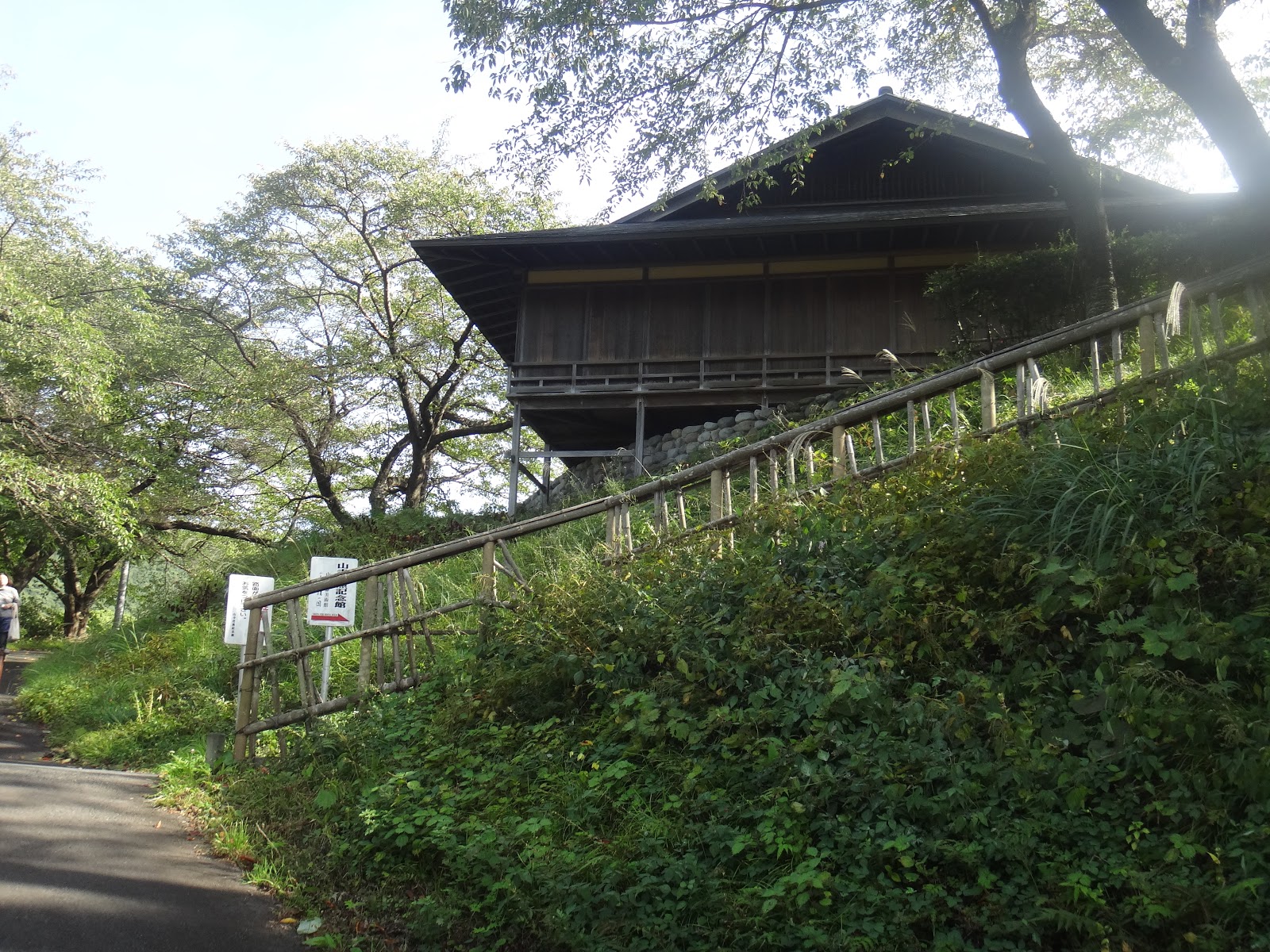
We found that we had about 50 minutes until the next train, so we decided to visit the Basho museum. It was, naturally, up a hill. As we approached the top, this building came into view.
Once we reached the top of the hill, we could see the grounds of the museum. I was surprised at the number of separate buildings.
The roadway was lined with stelae that contained haiku. I had no idea who the authors were, but it appeared that they were not famous.
We saw one building that looked old, or at least, constructed in the old traditional style.
Inside there was a gift shop and a meeting room for haiku sessions, among other things.
We found that we had about 50 minutes until the next train, so we decided to visit the Basho museum. It was, naturally, up a hill. As we approached the top, this building came into view.
Once we reached the top of the hill, we could see the grounds of the museum. I was surprised at the number of separate buildings.
The roadway was lined with stelae that contained haiku. I had no idea who the authors were, but it appeared that they were not famous.
We saw one building that looked old, or at least, constructed in the old traditional style.
Inside there was a gift shop and a meeting room for haiku sessions, among other things.
Nov 2, 2012
Yamadera
We passed the final building, which although outside the temple was still part of the complex.
Just beyond that building we came to a large cave that had a man-made support on the left side. The white objects are a row of rocks and beyond them the cave continues into the mountainside. This was (is?9 probably used as a meditation site.
We turned into the sun and toward the river and the bridge back into the small town.
From the bridge we could see the bridge that carries the train that will eventually take us back to Sendai. The only problem was that there is only one train an hour. But before worrying about that we decided to find someplace to eat.
We decided on this restaurant. We sat in the right hand corner nearest the large boulder. We had a great view of the river.
Just beyond that building we came to a large cave that had a man-made support on the left side. The white objects are a row of rocks and beyond them the cave continues into the mountainside. This was (is?9 probably used as a meditation site.
We turned into the sun and toward the river and the bridge back into the small town.
From the bridge we could see the bridge that carries the train that will eventually take us back to Sendai. The only problem was that there is only one train an hour. But before worrying about that we decided to find someplace to eat.
We decided on this restaurant. We sat in the right hand corner nearest the large boulder. We had a great view of the river.
Nov 1, 2012
Yamadera
Another narrow place in the path, This one is marked with a stone latern.
This is an incense burner. Again someone has left slats with names written on them as requests for favors. Although it is not part of the ultimate levels of Buddhism, many lay members make wishes at the altars and other special places.
Back down the mountain we turned right and walk along a path that we had not been on earlier. There were workmen taking a break in the shade of the gate. You can see them on the left of the pillars. They told us that this work was just normal periodic repairs and had nothing to do with the tremors.
Inside the gate I found this rather nice statue, probably of a Bodhisattva. By the way a Bodhisattva is someone who has almost reach enlightenment but who stays connected with society in order to assist others toward that goal.
Passed the statue, we found another temple. This one had a very interesting bell tower(?) outside. It was the smallest temple bell that I have ever seen.
Here is the same entrance from the other side.
This is an incense burner. Again someone has left slats with names written on them as requests for favors. Although it is not part of the ultimate levels of Buddhism, many lay members make wishes at the altars and other special places.
Back down the mountain we turned right and walk along a path that we had not been on earlier. There were workmen taking a break in the shade of the gate. You can see them on the left of the pillars. They told us that this work was just normal periodic repairs and had nothing to do with the tremors.
Inside the gate I found this rather nice statue, probably of a Bodhisattva. By the way a Bodhisattva is someone who has almost reach enlightenment but who stays connected with society in order to assist others toward that goal.
Passed the statue, we found another temple. This one had a very interesting bell tower(?) outside. It was the smallest temple bell that I have ever seen.
Here is the same entrance from the other side.
Labels:
bell tower,
Bodhisattva,
Buddhism,
Buddhist,
Yamadera,
Yamagata
Subscribe to:
Posts (Atom)
