This at the gift shop. This object, consisting of a wooden fish, an iron fish and some iron bamboo, is actually a hanger that goes of an open charcoal fire and holds a pot for heating tea water. The table in the back is covered with handmade hats.
It was getting near time to return to the station, so we did not explore the rest of the grounds or the actual museum. This is the hill that we had walked up to get to the grounds and were now walking down again.
From in front of the station, I got a view of the meditation hut on the mountain top.
We arrived at the station with about 10 minutes to spare. The strange looking two story building on the right is a viewing platform for people who want to see the temple buildings on the opposite mountain. The first floor contains public toilets. I did not go up on to the platform because I had had enough stairs for one day.
Just passed the viewing platform I noticed a gnarly old tree and took this picture of it.
It was still early so there were not too many people waiting for the train, which meant we had no problem in getting seats for our ride home. All and all it was a wonderful trip.
Showing posts with label Yamagata. Show all posts
Nov 4, 2012
Nov 3, 2012
Yamadera
We went back to the station and looked back at Yamadera on the mountain across the valley. I know that at first I called it a hill, but after climbing it, I think it deserves the grander title of mountain.
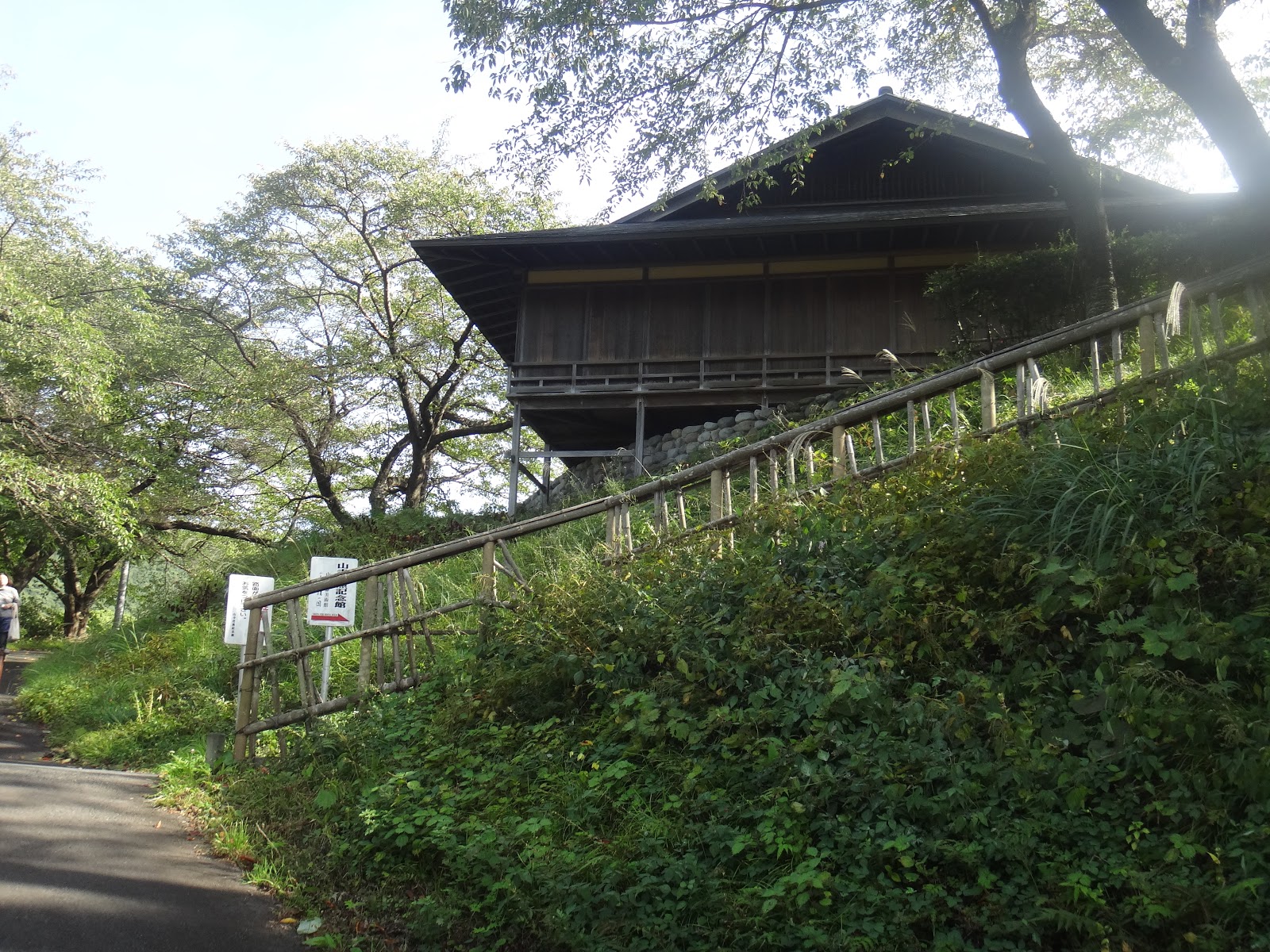
We found that we had about 50 minutes until the next train, so we decided to visit the Basho museum. It was, naturally, up a hill. As we approached the top, this building came into view.
Once we reached the top of the hill, we could see the grounds of the museum. I was surprised at the number of separate buildings.
The roadway was lined with stelae that contained haiku. I had no idea who the authors were, but it appeared that they were not famous.
We saw one building that looked old, or at least, constructed in the old traditional style.
Inside there was a gift shop and a meeting room for haiku sessions, among other things.
We found that we had about 50 minutes until the next train, so we decided to visit the Basho museum. It was, naturally, up a hill. As we approached the top, this building came into view.
Once we reached the top of the hill, we could see the grounds of the museum. I was surprised at the number of separate buildings.
The roadway was lined with stelae that contained haiku. I had no idea who the authors were, but it appeared that they were not famous.
We saw one building that looked old, or at least, constructed in the old traditional style.
Inside there was a gift shop and a meeting room for haiku sessions, among other things.
Nov 2, 2012
Yamadera
We passed the final building, which although outside the temple was still part of the complex.
Just beyond that building we came to a large cave that had a man-made support on the left side. The white objects are a row of rocks and beyond them the cave continues into the mountainside. This was (is?9 probably used as a meditation site.
We turned into the sun and toward the river and the bridge back into the small town.
From the bridge we could see the bridge that carries the train that will eventually take us back to Sendai. The only problem was that there is only one train an hour. But before worrying about that we decided to find someplace to eat.
We decided on this restaurant. We sat in the right hand corner nearest the large boulder. We had a great view of the river.
Just beyond that building we came to a large cave that had a man-made support on the left side. The white objects are a row of rocks and beyond them the cave continues into the mountainside. This was (is?9 probably used as a meditation site.
We turned into the sun and toward the river and the bridge back into the small town.
From the bridge we could see the bridge that carries the train that will eventually take us back to Sendai. The only problem was that there is only one train an hour. But before worrying about that we decided to find someplace to eat.
We decided on this restaurant. We sat in the right hand corner nearest the large boulder. We had a great view of the river.
Nov 1, 2012
Yamadera
Another narrow place in the path, This one is marked with a stone latern.
This is an incense burner. Again someone has left slats with names written on them as requests for favors. Although it is not part of the ultimate levels of Buddhism, many lay members make wishes at the altars and other special places.
Back down the mountain we turned right and walk along a path that we had not been on earlier. There were workmen taking a break in the shade of the gate. You can see them on the left of the pillars. They told us that this work was just normal periodic repairs and had nothing to do with the tremors.
Inside the gate I found this rather nice statue, probably of a Bodhisattva. By the way a Bodhisattva is someone who has almost reach enlightenment but who stays connected with society in order to assist others toward that goal.
Passed the statue, we found another temple. This one had a very interesting bell tower(?) outside. It was the smallest temple bell that I have ever seen.
Here is the same entrance from the other side.
This is an incense burner. Again someone has left slats with names written on them as requests for favors. Although it is not part of the ultimate levels of Buddhism, many lay members make wishes at the altars and other special places.
Back down the mountain we turned right and walk along a path that we had not been on earlier. There were workmen taking a break in the shade of the gate. You can see them on the left of the pillars. They told us that this work was just normal periodic repairs and had nothing to do with the tremors.
Inside the gate I found this rather nice statue, probably of a Bodhisattva. By the way a Bodhisattva is someone who has almost reach enlightenment but who stays connected with society in order to assist others toward that goal.
Passed the statue, we found another temple. This one had a very interesting bell tower(?) outside. It was the smallest temple bell that I have ever seen.
Here is the same entrance from the other side.
Labels:
bell tower,
Bodhisattva,
Buddhism,
Buddhist,
Yamadera,
Yamagata
Oct 31, 2012
Yamadera
This hole in the rock face (above the greenest leaves) was apparently a place for meditation. Throughout Japan many temples have such holes where a monk could go and meditate for long periods, often days, without having to contact other humans.
This stone lamp post seems to be wearing a stone straw hat.
This is a tree trunk that is completely covered with pieces of bamboo, apparently for protection against the snow which is very deep here every winter.
This is the view down through the branches to the next level. If you look carefully, you can see at least three or four people.
Here the stairs narrowed to not much more than the width of two shoes as the path passed between to large boulders.
This is a second trail that comes down from somewhere above. The next time I visit Yamadera I will follow this path just to see where it goes.
This stone lamp post seems to be wearing a stone straw hat.
This is a tree trunk that is completely covered with pieces of bamboo, apparently for protection against the snow which is very deep here every winter.
This is the view down through the branches to the next level. If you look carefully, you can see at least three or four people.
Here the stairs narrowed to not much more than the width of two shoes as the path passed between to large boulders.
This is a second trail that comes down from somewhere above. The next time I visit Yamadera I will follow this path just to see where it goes.
Oct 30, 2012
Yamadera
When not climbing long flights of stairs, the walk was very pleasant.
This large boulder has been hollowed out and behind the door there is a small wooden building containing a statue.
This building was old and in need of some repairs. There was a meditation room and altar off to the left but a bunch of noisy people, including one man who was talking with this office about work in a very load voice, arrived so we left before they broke the mood.
Starting back down the mountain, we could see across the valley.
As we went down each level, the mountains on the other side of the valley seemed to grow taller.
One of the administrative buildings had this huge set of pray beads. You were supposed to grasp the beads with one hand and pull down on them while reciting some sort of short group of words. Each bead was almost as big as my fist.
This large boulder has been hollowed out and behind the door there is a small wooden building containing a statue.
This building was old and in need of some repairs. There was a meditation room and altar off to the left but a bunch of noisy people, including one man who was talking with this office about work in a very load voice, arrived so we left before they broke the mood.
Starting back down the mountain, we could see across the valley.
As we went down each level, the mountains on the other side of the valley seemed to grow taller.
One of the administrative buildings had this huge set of pray beads. You were supposed to grasp the beads with one hand and pull down on them while reciting some sort of short group of words. Each bead was almost as big as my fist.
Oct 29, 2012
Yamadera
This stele had a bas-relief portrait of an actual person. It was placed here by the family to celebrate the life of a man who had been in the war between Japan and Russia just over a hundred years ago.
This is another temple and it looked very old.
This is a statue of an elephant. You can see it in the top right corner of the previous picture. Having an elephant here is very unusual, ordinarily there are lions, but I have no idea what the significance of it might be.
I found another unusual feature when I looked inside at the altar. The main object was a large mirror. I can understand the symbolism of looking at a reflection of yourself, but mirrors are usually found in Shinto shrines where the represent the reflection of the light from the sun god.
This building is a storehouse for valuable items. Notice the symbol up under the eaves. It looks like something you might find in Nazi Germany, but actually this is a 2,500 year old Buddhist symbol.
This is another temple and it looked very old.
This is a statue of an elephant. You can see it in the top right corner of the previous picture. Having an elephant here is very unusual, ordinarily there are lions, but I have no idea what the significance of it might be.
I found another unusual feature when I looked inside at the altar. The main object was a large mirror. I can understand the symbolism of looking at a reflection of yourself, but mirrors are usually found in Shinto shrines where the represent the reflection of the light from the sun god.
This building is a storehouse for valuable items. Notice the symbol up under the eaves. It looks like something you might find in Nazi Germany, but actually this is a 2,500 year old Buddhist symbol.
Oct 28, 2012
Yamadera
A group of stelae on a raised platform with a short flight of stairs.
We walked by another stone cliff and found that it was also covered with many one and five yen coins. One interesting thing about one yen coins is that they are made from aluminum and are so light that you can easily blow them off your hand.
The main temple buildings with stairs going up both sides.
On the opposite side from the one we took there was a bell tower.
At this level there was a roofed incense burner.
This large rock had a small pagoda carved out of it and some stelae in front to mark the site.
We walked by another stone cliff and found that it was also covered with many one and five yen coins. One interesting thing about one yen coins is that they are made from aluminum and are so light that you can easily blow them off your hand.
The main temple buildings with stairs going up both sides.
On the opposite side from the one we took there was a bell tower.
At this level there was a roofed incense burner.
This large rock had a small pagoda carved out of it and some stelae in front to mark the site.
Oct 27, 2012
Yamadera
This little building seem to be a meditation hall.
Going down one level, there was a good view of the buildings above. I think this is the residence for the priests who live in the temple. Some of the flat areas near the top had vegetable gardens in them, eliminating the necessity of carry fresh vegetables up the mountain side.
On the way down, one of the buildings had an newly opened door that gave me a good view of the altar. If you were able to be here early in the morning, I think that you would be able to join the priests in chanting sutras.
This little guy sat in front of the altar, outside but behind the rope for the bell. The sign said that rubbing the statue at the appropriate place would cure physical problems, especially those accompanying old age. My wife and I both rubbed it all over.
This was an amazing site. We were still near the top of the mountain and in lower levels of the main temple complex when we found a mail box.
The sign on the box indicates that the mail is picked up once every day. The kanji on the box read yubin or mail and the T-shape with the extra horizontal line is the symbol that is always prominently displayed on mailboxes and post offices.
Going down one level, there was a good view of the buildings above. I think this is the residence for the priests who live in the temple. Some of the flat areas near the top had vegetable gardens in them, eliminating the necessity of carry fresh vegetables up the mountain side.
On the way down, one of the buildings had an newly opened door that gave me a good view of the altar. If you were able to be here early in the morning, I think that you would be able to join the priests in chanting sutras.
This little guy sat in front of the altar, outside but behind the rope for the bell. The sign said that rubbing the statue at the appropriate place would cure physical problems, especially those accompanying old age. My wife and I both rubbed it all over.
This was an amazing site. We were still near the top of the mountain and in lower levels of the main temple complex when we found a mail box.
The sign on the box indicates that the mail is picked up once every day. The kanji on the box read yubin or mail and the T-shape with the extra horizontal line is the symbol that is always prominently displayed on mailboxes and post offices.
Subscribe to:
Posts (Atom)