Showing posts with label Shinrin Park. Show all posts

Dec 10, 2012

Views on the way to Asahigaoka


 I decided to walk to Asahigaoka, about a 10 kilometer round trip.
 As I passed the rich guy's house, I found that most of the siding on the second floor had been removed.
 
 At the Shinto shrine nearest our apartment, a maple was in full color. This tree has been trimmed so that it looks the same as a pine tree from a typical Japanese garden.
 I reached the bridge and stopped to look at the work on the coffer dam. They fill large woven plastic bags with dirt to make the main structure and then pile dirt against the bags.
 About half way to Asahigaoka, there is a pedestrian overpass. It was beginning to get very rusty and I think it would have soon become unusable, but they have started repairs on it. The entire bridge has been covered with cloth to protect the cars and pedestrians.
 A little further on, a large building is coming down. It will be interesting to see what replaces it.
 On the opposite side of the road, just a little ways up the road, the remains of a large Seiyu supermarket and game center was coming down fast. Walking around Sendai gives me the feeling that I am wandering through a battlefield after the fighting is over.
 This store sells ski equipment in the winter and surfing and scuba equipment in the summer. The interesting thing here, and one of the things that I love about Japan, is the boxes of skis that were left outside because the delivery truck came before the store opened. The nice thing is that you can expect them to remain there until the clerk from the store gets around to opening up and taking them inside.
Walking through Shinrin Park, I saw some very pretty red flowers.

Jul 13, 2012

Shinrin Koen and Asahigaoka

 Walking a bit further, I can see the Asahigaoka Subway Station and the Youth Center straight ahead
The archways open onto the platform of the subway station. In good weather many people use this area to wait for a subway. The trains come every seven minutes so you can come out hear for 10 minutes or more and know when to go back inside to catch a train.
 His man was sitting in the sun, reading.
 This is the main hall of the subway station. The wickets are straight ahead and the platform is one floor down.l
 Since I was out for a long walk, proceeded to the stairs that lead to the street.
As with most subway stations, there are long flights of stairs. There are also elevators and in busy stations escalators but many people use the stairs for exercise.

Jul 12, 2012

More at Shinrin Koen

 The last to set of pictures showed the path as it runs along the top of the hills. Finally I came down from the hills and reached the flat valley floor. The building on the left is the park admin center.
 There is a fairly large pond and the path goes all the way around it. When taking the route around the whole park, you can go on either side of the pond.
 The pond is full of water lilies. The people are feeding the carp that live in the pond. At sometimes during the year there are large numbers of ducks paddling around the pond.
 The metal work on the left is part of the Sendai Science Museum which is not part of the park but it is on the hill next to it. The road that runs in front of Asahigaoka passes in front of the museum.
 The structure on the left is a sitting area with a roof, which is all you can see of it.
Along one stretch of the path there are a number of sculptures of chickens.

Jul 4, 2012

Heading for Shinrin Koen

 At the convenience store, I turned left and could immediately see the subway entrance. It is on the left side of the tall trees on the right. Also this is a large bus stop.
 Next I walked through a small housing area and crossed this side road that leads to more homes. The large building in the distance is a activity center for the elderly.
 The center is on the right and apartment buildings on the hill to the left. These are the last buildings before the entrance to Shinrin Koen, Forest Park.
 This is the official entrance to the park.
 The roofed area has tables and seats, all made of concrete, where people stop to rest or eat and drink, usually snacks and soft drinks but some people have beer or sake. Also people use this as a smoking area, but they almost never use the whole space, just a single small area out of the weather. Smokers are becoming very considerate of other people.
Just passed the roofed area is the beginning of the walking path. It makes a big loop around the park, arriving back in this area at the other end of the roof.

Jul 23, 2011

Shinrin Park, Miyagi Gakuin U, and the riverside

 A while back I showed pictures of some banners advertising the Firefly Festival in Shinrin Park, where Ian and I walk. This is one of the pools where the fireflies hatch.
 The walking path climbs a hillside beside the firefly homestead, so we can look down on it. At this point the water is between two raised wooden walkways and is almost completely hidden by the weeds.
 This is a little later, after Ian and I had coffee and donuts at Mr Donut and I had arrived by bus at Miyagi Gakuin U. The hall that runs the length of the first floor of the main classroom building is now unlit, except for natural light from the windows. This is part of the effort to decrease the consumption of electricity to make up for the shortfalls due to tsunami and earthquake damage.
 The guerrilla rains of yesterday washed away a lot of the dirt that the construction along the riverside has moved. The hole on the right was big enough to standing.
 I usually cross the river on the east side of the bridge. The intersection at the end of the bridge is one of those new Sendai ideas to slow down pedestrians. The zebra crossings only go across three of the four sides. So when I come up from the riverside, to cross the road I have to wait for the light to walk north and then I have to wait for a full cycle (more than 3 minutes) to go west, before I can start south toward Yaotome. Needless to say I almost never do this, but today I was early and I had not seen the area on the west side of the bridge for a long time. There is a stream that enters the river just to the right of this picture and flows behind the power shovels. It is the same stream where they built a temporary road to repair the collapsed banking. They stabilized it have yet to fix it. The power shovels were being used to move the concrete blocks that they had removed from the banking at the construction site to the east of the bridge and shown in the second picture above.
The concrete blocks have been neatly placed in piles of 5 x5x4, or 100 blocks to the pile. There area about 6,000 blocks altogether. I assume that when the landscaping work is finished they are going to use the blocks to resurface the slope beside the river.

Jul 15, 2011

 It was Wednesday morning and I left home at 5:45  to met Ian at Kita Sendai station for a walk in Shinrin Park. As I followed the riverside path, I noticed that on the western horizon there were menacing clouds that looked as dark and substantial as the mountains themselves.
 The sections of wall that fell during the earthquakes have now been completely replace and the space between the walls and the levee filled with dirt. Both should survive any future earthquake without trouble.
 This is the view looking south from the platform at Yaotome station. The hill in the middle has a small park at the top to commemorate a visit by the Emperor Meiji when he was still only a prince. He was taken here during a visit to Sendai to see the lands to the north in the Nanakita River valley. It is the highest point for many kilometers on the south side of the river. This hill is also the place where there was an execution and torture ground. The bodies were dumped in a branch of the Nanakita River and hopefully were carried by the currents all the way to the ocean, about 16 kilometers to the east.
 This banner was in Shinrin Park. It is announcing hotaru matsuri, or a Firefly Festival.
This orange banner gives the details of when and where for the Firefly Festival and the white sign points the reader toward 'the home of fireflies and medaka' (little fish with bulging eyes [me in Japanese]).
Inside Asahigaoka Station is now quite dark. As a measure to protect against the 15% loss of electrical generating capacity, which was caused by damage from the earthquakes and the tsunamis, and the continuing problems with the nuclear generating plants, most public places either have no artificial lighting or it is reduced to a minimum. Both of the universities where I work have removed many of the light bulbs, two out of three, in the hallways, for example.

Jul 2, 2011

Shinrin Park

 This hole in the walking path has been this way since the first time I went to the park after the quakes. I suspect that it will remain this way for a long time. The disaster has caused so much disruption to the budget that there will be little money for fixing up a park while there is still major damage to whole cities along the coast.
 Walking in the park is peaceful and beautiful. If you go early in the morning, there are few people and you tend to see the same people each time. Friendly greetings are the order of the day and that pleasantness works in concert with the environment to make this a wonderful start to the day. Once I stop working next year, I think that I may go there more often.
 On the way back to Kita Sendai, we usually have to stop for a traffic light where we cross the main road into Sendai. It is the same road that goes through Izumi Chuo. The building in the middle looks very southern European (I have shown pictures of it before). The gray tarps are covering a pedestrian bridge that was damaged during the quakes and is now under reconstruction. I am not surprised that this one had problems, because it was very old and looked like it might fall down without any extra help, although it was still in regular use.
 On the back roads again, we saw this concrete block wall that had collapsed and had not been repaired (yet?)
 Almost back to Kita Sendai, we passed the gate into a Buddhist temple. This gate is at the top of a flight of stairs. One of these days I will have to stop and enter the grounds.
A little closer to our goal (the Mr Donuts at Kita Sendai, where we will have coffee and donuts before going to work),  this old style home seems to have weathered the tremors without serious problem.

Jul 1, 2011

 Having finished teaching two conversation classes at the Izumi Campus of Tohoku Gakuin U, I started home to have supper. The road between the campus buildings and the outside has a very spectacular view of the valley that was created by the river that flows by my home.
 The trees along this exit road have been severely trimmed, but the leaves are beginning to appear.
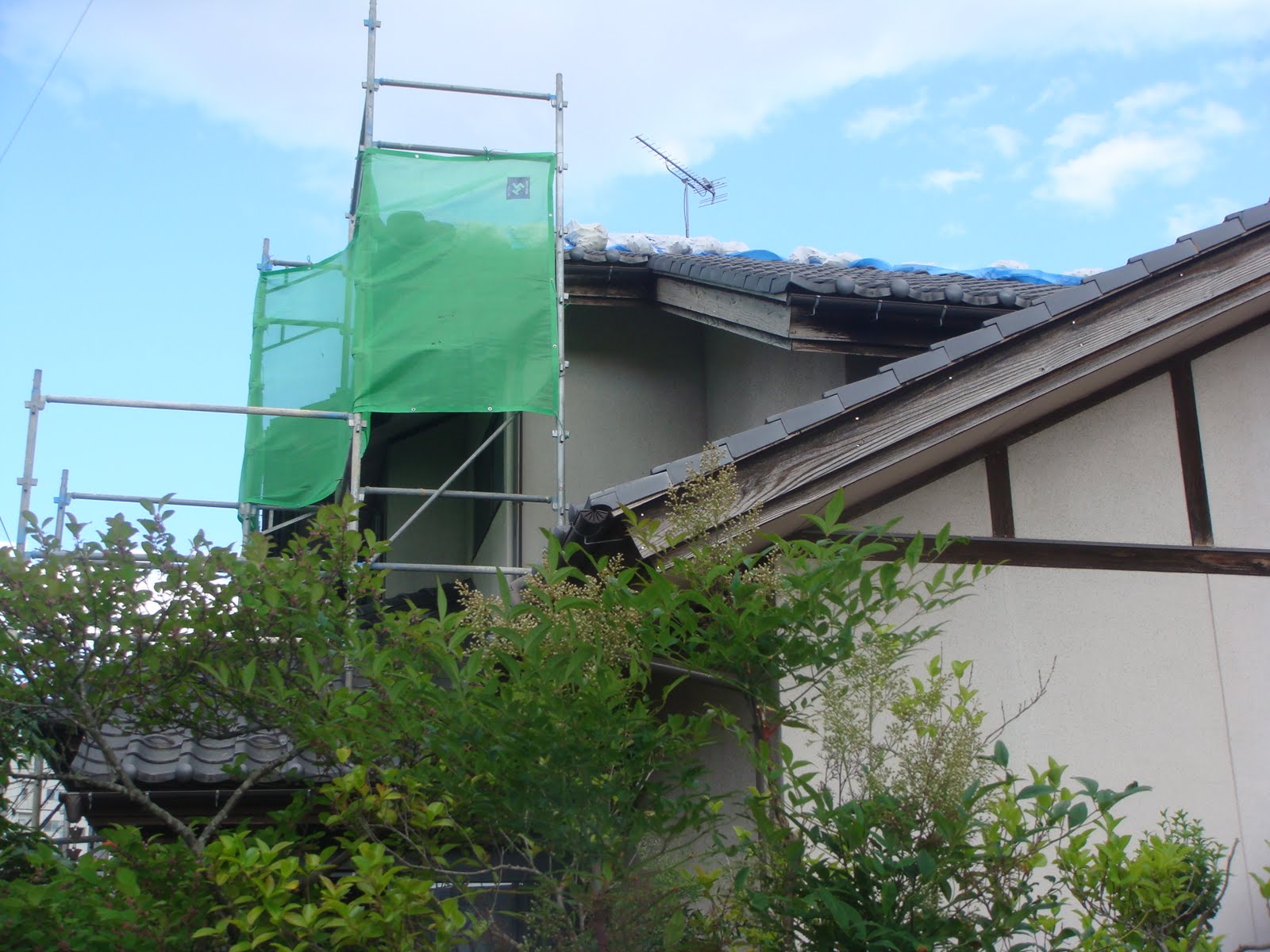
 About 15 minutes of walking brought me to a point more than half way home and a building having earthquake damage repaired. It appeared that there was some damage to the roof tiles and some cracks in the wall behind the green sheets.
 The next morning I left home at 5:45 to meet Ian and walk in Shinrin Park. We meet at the train station at Kita Sendai (North Sendai). A subway exit is nearby and the train station has this waiting room next to the ticket machines. The blue bag with red straps is the backpack that I use to carry things to school. I have a small computer on which I keep attendance, grades, and other records. I almost always have some other stuff, too - books, papers, or things like that.

Notice the rack of pamphlets. It is almost empty. These are for special trips and/or deals at hotels and spas. Because of the costs related to the disaster few people are taking vacations this year. The tourist industry for the whole country has been effected, but there are more problems in this area than else where.
 These racks are full, but they are schedules and ways of reducing the costs of traveling.
Inside the park we found evidence of the quakes. This shelter is leaning strongly to the right and looks like it might collapse at any time. The yellow plastic tape is commonly used to mark off areas that are officially, or semi-official, off limits for some reason. People almost always stay out of areas that are marked this way.