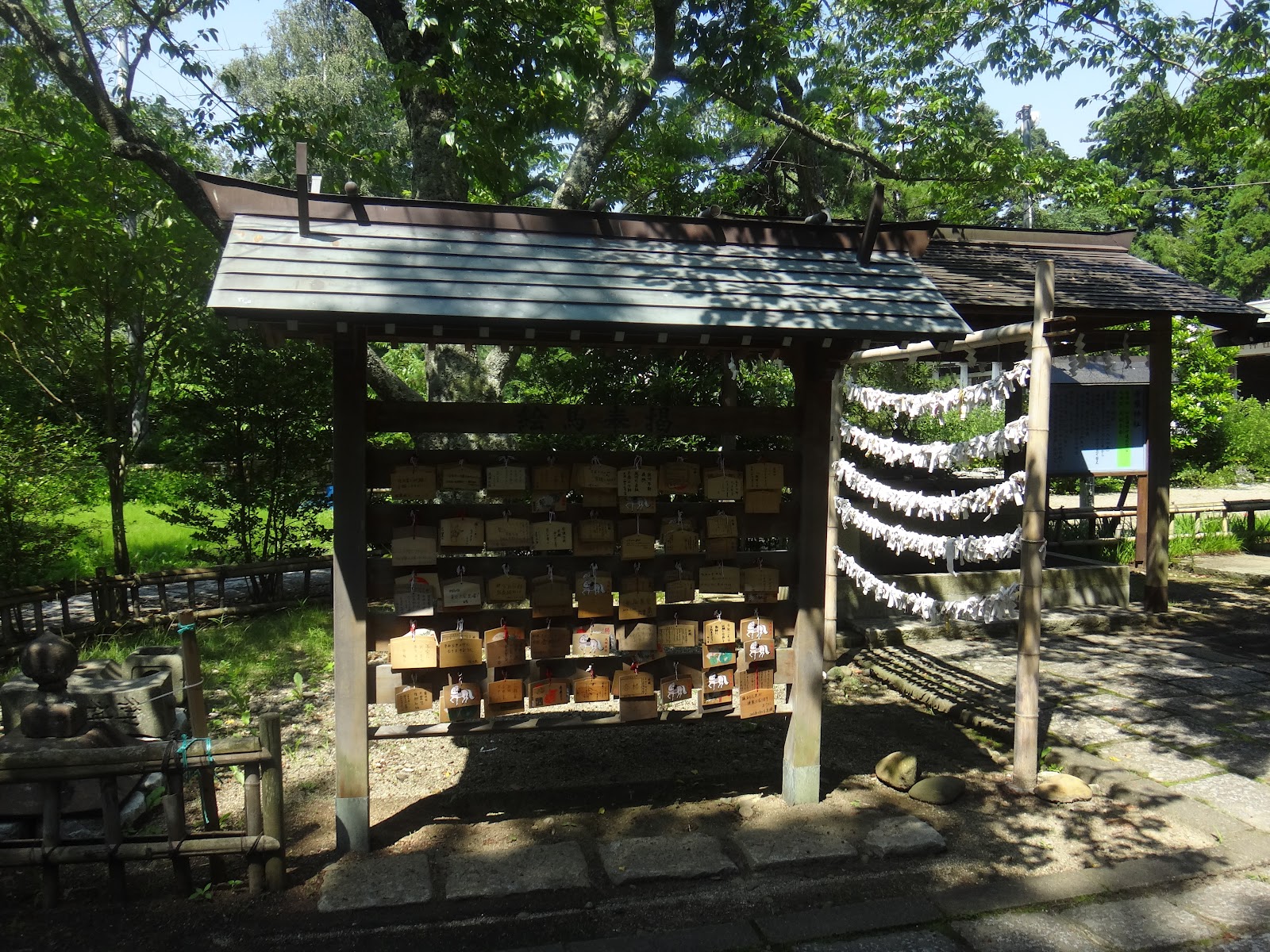
As I passed the main building of the Aoba Shrine, I discovered an outdoor display of amulets, good luck charms, and fortunes written on paper. You could buy any of them and it was by an honor system. There were boxes to leave the coins in.
This is the main building. The above display was at the right hand corner.
I followed the path and came to some traditional style building but I could not determine what they were, or even if they were part of the shrine or the next temple.
This appeared to be the remains of a torii or a statue. However, the broken pieces had been cleaned up so it was impossible to tell.
I returned to the street and headed for my next goal, a Buddhist temple. However, I looked up and discovered this very strange building. The triangular section at the front of the roof seemed to have been added after the rest had been built. That was not unusual but what was strange was the covered rampway leading from the taller back of the building to this new section. The triangular section was actually two parts separated by an opening in the middle. I could not tell exactly how the ramp and the new section went together but I have never seen anything else like it.
Showing posts with label jinja. Show all posts
Sep 1, 2012
Aug 30, 2012
At Aoba Jinja
This appears to be a Buddhist pagoda but it seems to be on the grounds of the Shinto shrine. Over the years, especially just before and during WW2, Buddhism and Shinto became mixed. The priests will even substitute for each other in cases where a shrine or a temple has no one to look after it.
These are little, about 10 cm wide, pieces of wood on which people will write their wishes. They are then left for the gods of the shrine, who hopefully will help make them come true. They are called ema, or picture horse, in Japanese. I used to know the derivation of the name but it escapes me at the moment.
The ema are tied to horizontal boards under a roof. Here on the right, people have left the white sheets of paper that contain their fortune. You buy these from the shrine for 50 to 200 yen, and after looking at them, you tie them to a tree or often a specially construction of ropes tied between to poles. The idea is that the local gods will help a god fortune actually come about and, if you have a bad prediction, the gods will help keep it from being actualized.
Under this roof is a fountain where you can purify yourself before approaching the shrine building. The bulletin board on the right contains instructions for doing this. You always wash your hands and sometimes you also rinse your mouth and maybe even wash your face.
The water outlet is almost always in the form of a dragon. This is the one from the above picture.
This is the bell rope, in the middle with the colored cloth, and beyond it stairs up to the entrance to the building. In the front is a large box for coins, gifts for the gods. People seldom give more than 100 yen and even 1 yen coins are common. I guess the point is that the gods are not physical so they really have no use for money. It is the thought that counts. As you can see onright, the stairs were blocked by a fence so I was unable to get much closer.
These are little, about 10 cm wide, pieces of wood on which people will write their wishes. They are then left for the gods of the shrine, who hopefully will help make them come true. They are called ema, or picture horse, in Japanese. I used to know the derivation of the name but it escapes me at the moment.
The ema are tied to horizontal boards under a roof. Here on the right, people have left the white sheets of paper that contain their fortune. You buy these from the shrine for 50 to 200 yen, and after looking at them, you tie them to a tree or often a specially construction of ropes tied between to poles. The idea is that the local gods will help a god fortune actually come about and, if you have a bad prediction, the gods will help keep it from being actualized.
Under this roof is a fountain where you can purify yourself before approaching the shrine building. The bulletin board on the right contains instructions for doing this. You always wash your hands and sometimes you also rinse your mouth and maybe even wash your face.
The water outlet is almost always in the form of a dragon. This is the one from the above picture.
This is the bell rope, in the middle with the colored cloth, and beyond it stairs up to the entrance to the building. In the front is a large box for coins, gifts for the gods. People seldom give more than 100 yen and even 1 yen coins are common. I guess the point is that the gods are not physical so they really have no use for money. It is the thought that counts. As you can see onright, the stairs were blocked by a fence so I was unable to get much closer.
Aug 28, 2012
From Toshoji to Aoba Jinja
I was not at all sure when the grounds of Toshoji ended and those of Aoba Jinja started. but I found I could go no farther west along the hill top but had to go down a flight of stairs leading in the direction of the road.
The sides of these stairs contained very overgrown yards around what appeared to be deserted residential buildings that were probably homes for the priests in the past.
These steps seemed to lead to nowhere. Maybe the lead to the Buddhist idea of emptiness.
At the bottom of the hill, there was a place to wash your hands before entering the grounds.
At the intersection of the stairs and the street, there was a small building containing a Buddhist statue so I assumed that I was still on the grounds of Toshoji.
This was actually confirmed when I went out onto the street and continued west for a few tens of meters. I found a stele that marked the entrance to Aoba Jinja. Aoba means green leaf or green leaves in Japanese. One of the main festivals in Sendai is called the Aoba Festival.
The sides of these stairs contained very overgrown yards around what appeared to be deserted residential buildings that were probably homes for the priests in the past.
These steps seemed to lead to nowhere. Maybe the lead to the Buddhist idea of emptiness.
At the bottom of the hill, there was a place to wash your hands before entering the grounds.
At the intersection of the stairs and the street, there was a small building containing a Buddhist statue so I assumed that I was still on the grounds of Toshoji.
This was actually confirmed when I went out onto the street and continued west for a few tens of meters. I found a stele that marked the entrance to Aoba Jinja. Aoba means green leaf or green leaves in Japanese. One of the main festivals in Sendai is called the Aoba Festival.
Aug 23, 2012
As I mentioned in my last post, I wanted to visit the shrine, Yamamkami Jinja, that was shown on my map but I could not find it. I wander around for a long time and finally decided to give up. But as I started up a road that would take me toward home, I found a sign.
This sign was on the side of a fence and referred to the shrine. However, the fence paralleled what appeared to be a driveway. At the end was a flight of stairs. When I climbed the stairs I found a locked gate, but over the top I could see the shrine in the distance. It was obvious that the gate led to private property because there was another gateless fence in front of the shrine.
On the right side there was a small model shrine that appeared to be very old. Inside the door was a small statue of a god, who probably has something to do with mountains since the name of the shrine, Yamakami, means mountain god.
Looking closer at the god inside the shrine, it appeared to be a fox, which is a common representation of a god at Japanese shrines.
I next looked inside the main building. The building enshrined a large stone. I wished that there was someone around who could tell me the story of this rock, but there was no one there and there was no place for a priest to live.
On the left side it was possible to see some gravestones and part of the graveyard at the temple, Zen'oji. Even further to the left there was a small stone stele.
After a very long walk, getting lost, and searching for the shrine, I was very tired so I decided that it was time to head for home. Since I now knew where I was, I looked at my map to determine the best route. I decided that I would head northwest and go to a subway station and ride part way home. However, the best laid plans of mice and men ...........
This sign was on the side of a fence and referred to the shrine. However, the fence paralleled what appeared to be a driveway. At the end was a flight of stairs. When I climbed the stairs I found a locked gate, but over the top I could see the shrine in the distance. It was obvious that the gate led to private property because there was another gateless fence in front of the shrine.
Finally, I realized that it was possible to go around the left side of that private property on a very narrow and overgrown path. This is a picture looking back down the path toward the road.
I finally reached the torii and could see the small shrine building just behind it.On the right side there was a small model shrine that appeared to be very old. Inside the door was a small statue of a god, who probably has something to do with mountains since the name of the shrine, Yamakami, means mountain god.
Looking closer at the god inside the shrine, it appeared to be a fox, which is a common representation of a god at Japanese shrines.
I next looked inside the main building. The building enshrined a large stone. I wished that there was someone around who could tell me the story of this rock, but there was no one there and there was no place for a priest to live.
On the left side it was possible to see some gravestones and part of the graveyard at the temple, Zen'oji. Even further to the left there was a small stone stele.
After a very long walk, getting lost, and searching for the shrine, I was very tired so I decided that it was time to head for home. Since I now knew where I was, I looked at my map to determine the best route. I decided that I would head northwest and go to a subway station and ride part way home. However, the best laid plans of mice and men ...........
Labels:
Japan,
jinja,
Miyagi,
Sendai,
Shinto,
Shinto shrine,
Yamakami Jinja
Jun 27, 2012
More at the temple and shrine and then walking more
This is the altar inside Toyokawa Inari Jinja.
This is the house on the right of the shrine. It probably belongs to the caretaker, who is probably a Buddhist priest who also functions as a Shinto priest. I have seen this arrangement many times. It happens because Japan is getting less religious and fewer people are becoming priests, especially Shinto priests.
As I was returning to the road, I noticed that, in the back of the building holding that first statue, there was a Buddhist altar in a very small room. The building was very small and at the street had that room with the statue, behind it was the stairs to the second floor, and at the very inside end of the building this altar.
A little further down the street, I found this old style house.
Just beyond it, I found this modern home but with a traditional Japanese garden.
I was crossing the last wide street before reaching the station, when I noticed this group of women. They were weeding and picking up the trash that had accumulated in the bed of plants.
This is the house on the right of the shrine. It probably belongs to the caretaker, who is probably a Buddhist priest who also functions as a Shinto priest. I have seen this arrangement many times. It happens because Japan is getting less religious and fewer people are becoming priests, especially Shinto priests.
As I was returning to the road, I noticed that, in the back of the building holding that first statue, there was a Buddhist altar in a very small room. The building was very small and at the street had that room with the statue, behind it was the stairs to the second floor, and at the very inside end of the building this altar.
A little further down the street, I found this old style house.
Just beyond it, I found this modern home but with a traditional Japanese garden.
I was crossing the last wide street before reaching the station, when I noticed this group of women. They were weeding and picking up the trash that had accumulated in the bed of plants.
Subscribe to:
Posts (Atom)