
There were some interesting things on TV and in the newspapers and magazines that I thought some of you might be interested in.
One of the local universities has developed a new kind of panel for ceilings that is so light weight that, even if it falls on a person, it will not cause injury. It is made from some kind of filament and is projected to be relatively cheap to manufacture. Much of the damage and injuries during earthquakes is caused by ceilings collapsing, air conditioning falling, and the fire extinguishing system breaking, covering everything with water.
In Onagawa, one of the cities hardest hit by the tsunami, a group of local trade people have banded together to start doing business again. They have rented(?) a parking lot on a hillside and have placed a large number of shipping containers in it. The containers have been modified and painted to become stores. They seem to be selling every that is necessary. During the TV news program I saw a meat store, a vegetable store, a flower shop, an electronics store, a couple of restaurants, a bar, and other containers that were not shown in detail. I thought that this was a very good solution to a very important problem.
One big problem that remains, among all the other problems, is what to do about the areas that were ravished by the tsunami. There are three prefectures and many other smaller administrative units involved so the solutions will be a bit different in each locale. However, it appears that the solutions will all be similar, at least to the extent that they will all involve rezoning in ways that will limit the damage by future tsunamis. Most areas are going to require that housing be inland and on raised ground. Also there will be three of four distinct areas with port or ocean-side facilities nearest the ocean, then an industrial area, and finally a shopping zone. In some areas there may be farm land between the port and the industrial area. The areas will be separated by high levees to retard waves. The tops of the levees will carry roads and train lines. This will, of course, cost a huge amount of money and take years to accomplish, but the government seems to be serious about it.
I saw a book the other day. It summarized the damage done during March and April. Unbelievable! According to the book, there were 23,773 people killed or missing plus another 5363 badly injured. 107,748 homes were totally destroyed, 63,083 half destroyed, 298,051 partially destroyed and another 7079 that were flooded. These are the figures for insurance purposes. This is all to say nothing of the nuclear problem, for which it is difficult to get much information, but the local newspaper now has a daily column showing how much radiation is being recorded in cities around the prefecture. In Sendai we have about half of the radiation that is normal in England, so it is not a problem.
Another point from the book is the difference in the number of aftershocks. Previous earthquakes had around 50 aftershocks of magnitude 5 and above during the first 70 days after the main tremor. There was one quake near Okinawa in 2003 that that broke the pattern had slightly more than 100. However, the March magnitude 9.0 quake had 533. And we are still having them. According to a different source we have had 1437 aftershocks of magnitude 4.0 and above.
In spite of this, things are finally beginning to quiet down a bit and on some days there are no quakes at all and on many days there are none that you can feel. Last Friday there was one while I was teaching. I was standing and did not even notice it, but the students who were sitting at computer consoles all felt it and got excited. As proof they pointed out to me that the projector, hanging from the ceiling, was swinging quite a bit. It was not bad so we just commented on it and got back to work. People are getting used to them. A quake that might in the past have elicited screams from some of the students, now hardly creates any stir at all. A quake has to be at least shindo4 to have a reaction more than a slight pause, before a return to work.
Showing posts with label disaster. Show all posts
Showing posts with label disaster. Show all posts


Jul 8, 2011
The current state of affairs at Izumi Chuo


Jul 5, 2011
At Asahigaoka


Jun 23, 2011
In the park near my condo
I have had a very busy two days. The day before yesterday, Wednesday, I got up at 4 a.m. and left home around 5:30. After walking to the Yaotome Subway station I took a train to the Kita Sendai Station, where I met Ian for a walk around Shinrin Koen, the park that we have been walking in for a few years. After returning to Kita Sendai, we stopped at our favorite Mr Donuts for coffee and donuts. Ian had to leave earlier than usual and, as we were saying goodby on the sidewalk outside, I noticed that the destination of the bus standing at the bus stop was Miyagi Gakuin University. So, I quickly hopped on and went to school, getting there before 9 a.m. This was a bit of a problem because my class did not start until 2:10 in the afternoon. However, I found good ways to spend the day. Much of the time was used trying to figure out the solution to a problem we are having with the computerized listening program. I had lunch with one of the Japanese teachers and used most of the remaining time to listen to a recording of The Odyssey. My classes were over at 5 and I got home about 6:15, a more than 12 hour day.
I have a first period class on Thursday so I leave about 6:45. The Rainy Season has started and they were forecasting very heavy rain so I decided to stay at school, leaving for my evening class late in the afternoon. A very enjoyable discussion with my friend John, followed by lunch together, occupied the morning and early afternoon. I spend the rest of the afternoon sitting in the air conditioned teachers' lounge reading a Japanese children's book about Walt Disney. About 4 I took a bus and subway to Tohoku Gakuin U's Tsuchitoi campus and again sat in the teachers' lounge, where I ate the fried chicken, rice, and vegetable box lunch, bento in Japanese, that I had bought in a local supermarket. Class was over at 7:30 and a very tired I got home a little after 8.
On my way to school in the morning there was an earthquake which, although it was large in terms of magnitude, was far enough away that I barely felt it. I was walking along the riverside at the time and was not even sure that it was a quake. Unless a quake is very strong they are not particularly noticeable if you are moving. On my way home from my last class, there was another quake. I was in the underground Tsuchitoi Subway station and again barely felt it. I was sure it was a quake because a sign that was securely attached to the ceiling started moving. Both quakes were quite large in terms of magnitude, but nothing special in terms of the Japanese Shindo system that quantifies the actually movement at each spot on the ground. They were both Shindo 4 on a scale of 1 to 7 (no decimals). This is the strongest quake that does not cause damage, although a few objects may fall over.
 This is outside my condo. The ground used to be completely level here. Now, the entire area above the drain has sunk, some of it more than 50 centimeters. I took the picture as I was leaving for a short walk in the park that is next to my building and along the river.
 I showed this before. The slanted portion of the facing along the river bank slide down toward the river during the quakes. I noticed that since the major quakes this section has slide even farther toward the river, opening up a large gap between the path and the siding.
 This area is a popular fishing spot and the man on the other side of the river was fishing. The river supports populations of various species of fish at different times of year, so I do not know what he was hoping to catch.
 On the other side of the river there is a large section that collapsed during the tremors. Very quickly it had been covered with blue tarps, but now there are sandbags neatly placed to keep the tarps from blowing away.
 A house on the other side of the river was having the roof replaced.
 In the large flat area of the park, some of the local boys were having a baseball game.

I have a first period class on Thursday so I leave about 6:45. The Rainy Season has started and they were forecasting very heavy rain so I decided to stay at school, leaving for my evening class late in the afternoon. A very enjoyable discussion with my friend John, followed by lunch together, occupied the morning and early afternoon. I spend the rest of the afternoon sitting in the air conditioned teachers' lounge reading a Japanese children's book about Walt Disney. About 4 I took a bus and subway to Tohoku Gakuin U's Tsuchitoi campus and again sat in the teachers' lounge, where I ate the fried chicken, rice, and vegetable box lunch, bento in Japanese, that I had bought in a local supermarket. Class was over at 7:30 and a very tired I got home a little after 8.
On my way to school in the morning there was an earthquake which, although it was large in terms of magnitude, was far enough away that I barely felt it. I was walking along the riverside at the time and was not even sure that it was a quake. Unless a quake is very strong they are not particularly noticeable if you are moving. On my way home from my last class, there was another quake. I was in the underground Tsuchitoi Subway station and again barely felt it. I was sure it was a quake because a sign that was securely attached to the ceiling started moving. Both quakes were quite large in terms of magnitude, but nothing special in terms of the Japanese Shindo system that quantifies the actually movement at each spot on the ground. They were both Shindo 4 on a scale of 1 to 7 (no decimals). This is the strongest quake that does not cause damage, although a few objects may fall over.


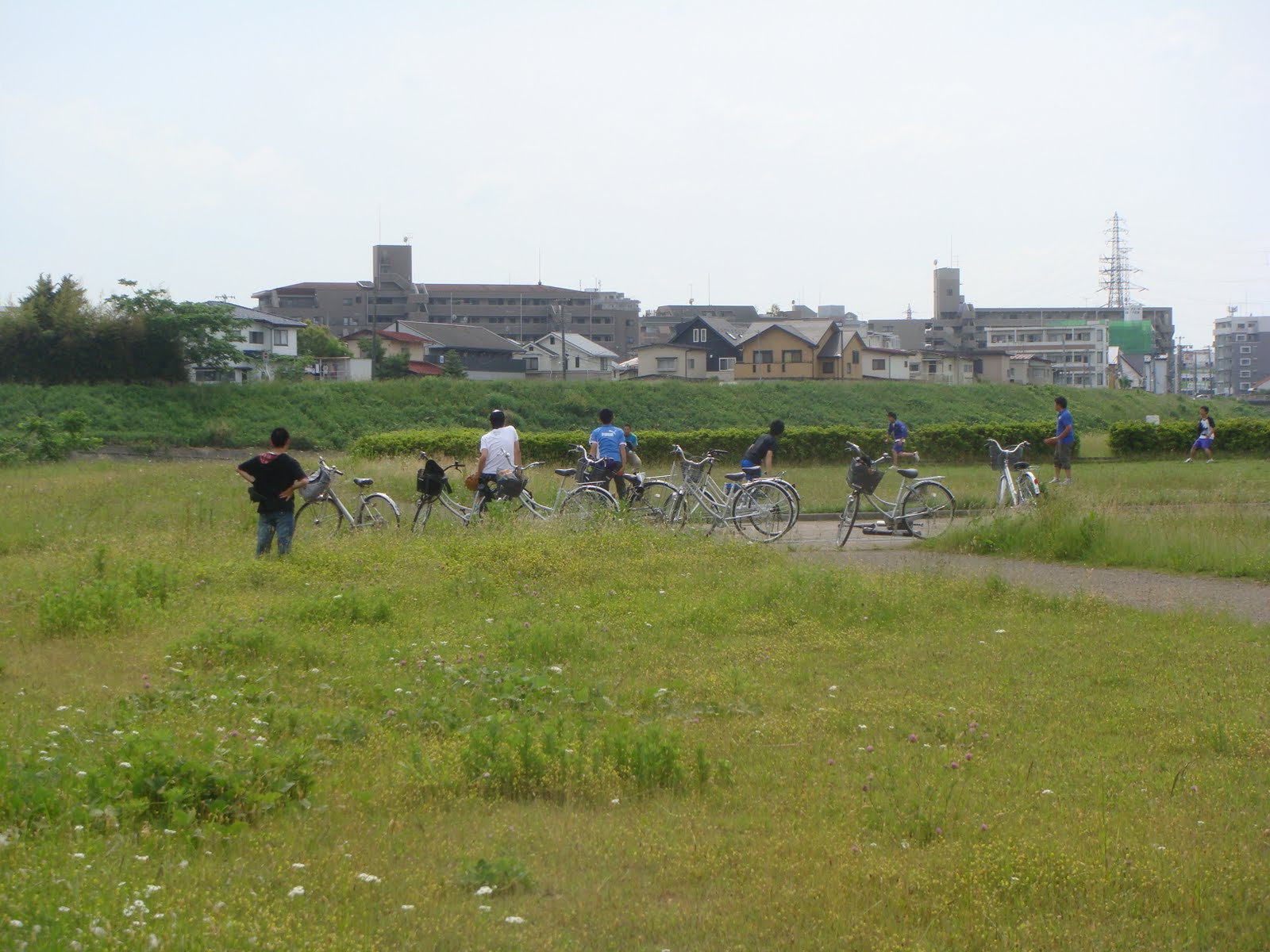
One common feature of Sendai parks, one that makes baseball and other games difficult, is that the grass is usually mowed on twice a year or at most three times. You can see in this picture that it looks more like an empty lot than a nicely trimmed park.
Jun 21, 2011
Miyagi Gakuin University and the Sendai Book Club
The weather bureau has forecast that the rainy season will official start in southwestern Japan today. Our weather here in the north is just like the full rainy season - hot and muggy. They are forecasting temperatures above 27C (81F) for the rest of the week and rain every day. The rainy season is expected to officially start later in the week. The official start comes when a set or criteria are met, not just by rain, heat, and humidity.


The Sendai Book Club


Jun 20, 2011
More about Miyagi Gakuin U


Jun 19, 2011
At and between my universities


PS: This is Father's Day, so Happy Father's Day to any fathers who are reading this.
Jun 18, 2011
Son of around the neighborhood


Jun 17, 2011
Around the neighborhood - part ???


This is the front parking lot at Seiyu. They are working on the tower that rises above the entrance. We are still expecting that supermarket and a reduced version of the department store will reopen in July.


Changing the subject completely, my life has changed substantially. Yesterday the cable company came and installed our new TV/telephone/computer system. All the channels on the TV have new numbers and the remote has a large number of new features. Also there are a lot of new channels. My internet connection speed has been increase by 33% and any telephone calls we make to AU phones are now free anywhere in Japan. The whole package will cost us substantially less than we were paying before.
Subscribe to:
Posts (Atom)